

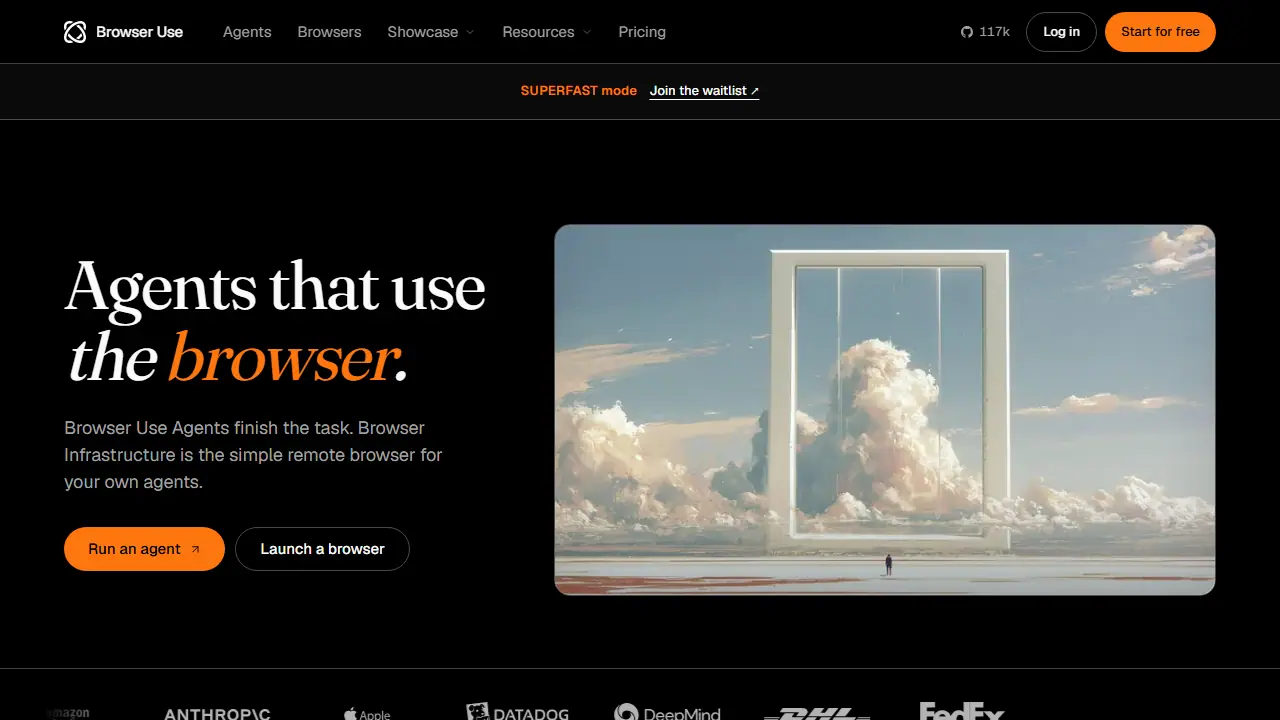
What is Browser Use?
Browser Use is a product with two parts. Browser Use Agents take a task in natural language and run it in a browser for you, using an AI model; the company says its agent scored 82% on its 106-task Internal Bench Hard benchmark at 17 cents per solved task. Browser Infrastructure is a managed remote browser for your own agents and automation, available through an SDK, a REST API, or the Chrome DevTools Protocol (CDP). You paste a connection URL and your code drives the browser.
In practice you can use it to run web tasks such as form filling, login automation, data extraction, shopping and checkout, research, and testing, including on sites that block standard automation. The browser is billed at $0.02 per hour plus traffic, with residential proxies on by default. The core project is open source under the MIT licence and has about 117k stars on GitHub.
Key features
- Browser Use Agents that complete web tasks from a natural-language instruction
- Managed remote browsers started with a connection URL
- SDK, REST API and CDP access for your own agents
- Residential proxies on by default, or bring your own proxy
- Pay-as-you-go credits with no subscription and no expiry
- Open-source core library under MIT licence
Who is it for
- AI startups building web agents
- automation and QA teams
- developers running Playwright or CDP-based browser automation
- enterprises needing SOC 2, HIPAA or custom data policies
How to get started with Browser Use
- Sign up with Google, GitHub or Microsoft, no card required.
- Choose your path: delegate a task to an agent or use a remote browser.
- For an agent, describe the task and run it; for SDK, paste the Playwright connection address.
- You want to delegate a browser task to an agent, e.g. filling a form or collecting data.
- You are building your own automation or AI agent and need remote browsers controlled from code.
- You work on bot-protected sites and need a built-in proxy.
- You need a free plan long-term, since beyond the one-time $1 credit there is no free option.
- You require a Polish-language interface, as there is no Polish UI.
Pros and cons
- Benchmarked by the vendor as more accurate and cheaper per solved task than compared models
- Works on protected sites, per the vendor's 71-site benchmark
- Open-source core with a large GitHub following
- Model token costs are added on top of browser time for the agent product
- Concurrency is capped at 10 sessions until lifetime spend grows
Browser Use pricing
| Plan | Price | Includes |
|---|---|---|
| Browsers | 0.02 USD / godz. | Plus internet traffic. Residential proxies at 5 USD/GB, or 0.20 USD/GB with your own proxy. |
| Browser Use Agents | 1.20 USD / one-time | Example: $1 in model tokens plus 20% service fee. Browser time and traffic billed extra. |
Prices copied from Browser Use pricing, checked October 12, 2026. Currency as shown by the vendor; taxes may apply.
Is Browser Use free?
There is a free trial. $1 in free credits once per person for eligible Google, GitHub or Microsoft signups, no card required. Credits start from a $5 minimum top-up.
Featured in
- Best AI for AI agents - #10
- Best AI for automation - #10
Browser Use alternatives
| Tool | Price from | Free plan | Category |
|---|---|---|---|
 Zapier Zapier | od 19,99 USD/mo | yes | Automation |
 Browserbase Browserbase | 20 USD/mo | yes | Automation |
 n8n n8n | 20 EUR/mo | trial | Automation |
 Clay Clay | od 167 USD/mo | trial | Automation |
 Skyvern Skyvern | 29 USD/mo | yes | Automation |
 Simular Simular | 50 USD/mo | no | Automation |
All alternatives to Browser Use →
Comparisons
FAQ
What is Browser Use used for?
Remote browsers and web agents for AI startups and automation teams, including on protected sites, via SDK, REST, or CDP.
Is Browser Use free?
There is a free trial. $1 in free credits once per person for eligible Google, GitHub or Microsoft signups, no card required. Credits start from a $5 minimum top-up.
How much does Browser Use cost?
The cheapest paid plan is 0.02 USD (vendor pricing, October 12, 2026).
What are the best Browser Use alternatives?
Closest alternatives: Zapier, Browserbase, n8n, Clay, Skyvern.
Data checked October 12, 2026 on the vendor website (browser-use.com).