

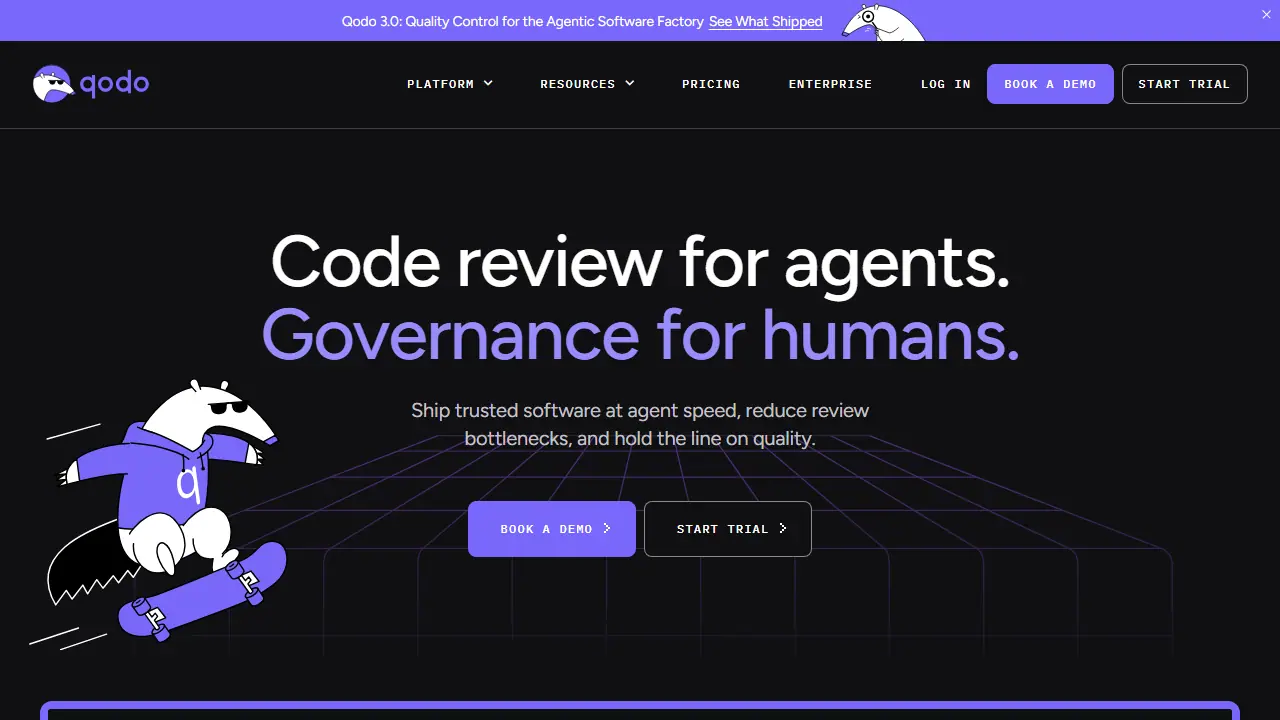
What is Qodo?
Qodo is an AI code review platform built for teams that ship code written with AI coding agents. Its specialized review agents run on every pull request and reason over full codebase context, flagging real bugs, rule violations and gaps against requirements, with the aim of producing less noise than generic reviewers. A context engine draws on the repository structure and dependencies, past PR diffs and comments, and business requirements from tickets and specs.
Beyond PR review, the platform lets teams turn wikis and tribal knowledge into machine-readable rules that developers, reviewers and agents can follow, and tracks how often those rules are violated and resolved before merge. Review skills can run inside the developer's IDE, and a cross-repo view maps how repositories and services connect so breaking changes can be caught early. Governance dashboards and audit logs give engineering leaders visibility into risk and resolution rates across teams.
Key features
- Context-aware AI review on every pull request
- Self-learning rules system for coding standards
- IDE review skills that run inside the developer's agent
- Cross-repo impact analysis and software map
- Risk and resolution analytics dashboard
- Audit trail of findings and compliance flags
Who is it for
- Software engineering teams
- Engineering managers and tech leads
- Platform and security teams
- Enterprises with multiple repositories
How to get started with Qodo
- Create an account and start the 14-day free trial, no credit card needed.
- Connect your repository to the Qodo platform.
- Open a pull request and check the automatic code review.
- Your development team wants automatic code review for every pull request.
- You need analysis with full repository context and PR history.
- You want to catch coding standard violations and requirement gaps before merging changes.
- You need a permanent free plan, but only a 14-day trial is available.
- You need SSO, audit logs, or on-prem deployment, which are only in the Enterprise plan.
Pros and cons
- Reviews reason over full codebase context and PR history
- Rules are learned from existing patterns and enforced consistently
- Free 14-day trial with no credit card required
- Advanced features such as SSO, audit logs, BYOK and Gerrit support are limited to Enterprise
- Pricing is credit-based, so review volume determines actual cost
Qodo pricing
| Plan | Price | Includes |
|---|---|---|
| Pro Team | 30 USD / month | Designed for up to 30 users; credits pooled across the team at 0.012 USD per credit; 2,500 to 20,000 credits depending on pack; monthly billing with no annual commitment; no rate limits |
Prices copied from Qodo pricing, checked October 12, 2026. Currency as shown by the vendor; taxes may apply.
Is Qodo free?
There is a free trial. 14-day free trial with no credit card required; the page describes it as including unlimited reviews and unlimited credits.
Qodo alternatives
| Tool | Price from | Free plan | Category |
|---|---|---|---|
 Grammarly Grammarly | 12 USD/mo | yes | Writing & editing |
 QuillBot QuillBot | not listed | ? | Writing & editing |
 LanguageTool LanguageTool | 49,90 PLN/mo | yes | Writing & editing |
 Canva Canva | 450 PLN/yr | yes | Writing & editing |
 Rytr Rytr | 7.50 USD/mo | yes | Writing & editing |
 Sudowrite Sudowrite | 10 USD/mo | trial | Writing & editing |
Comparisons
FAQ
What is Qodo used for?
AI code review platform giving engineering teams codebase-aware PR review, enforceable coding rules and quality governance for AI-assisted development.
Is Qodo free?
There is a free trial. 14-day free trial with no credit card required; the page describes it as including unlimited reviews and unlimited credits.
How much does Qodo cost?
The cheapest paid plan is 30 USD/mo (vendor pricing, October 12, 2026).
What are the best Qodo alternatives?
Closest alternatives: Grammarly, QuillBot, LanguageTool, Canva, Rytr.
Data checked October 12, 2026 on the vendor website (qodo.ai).