

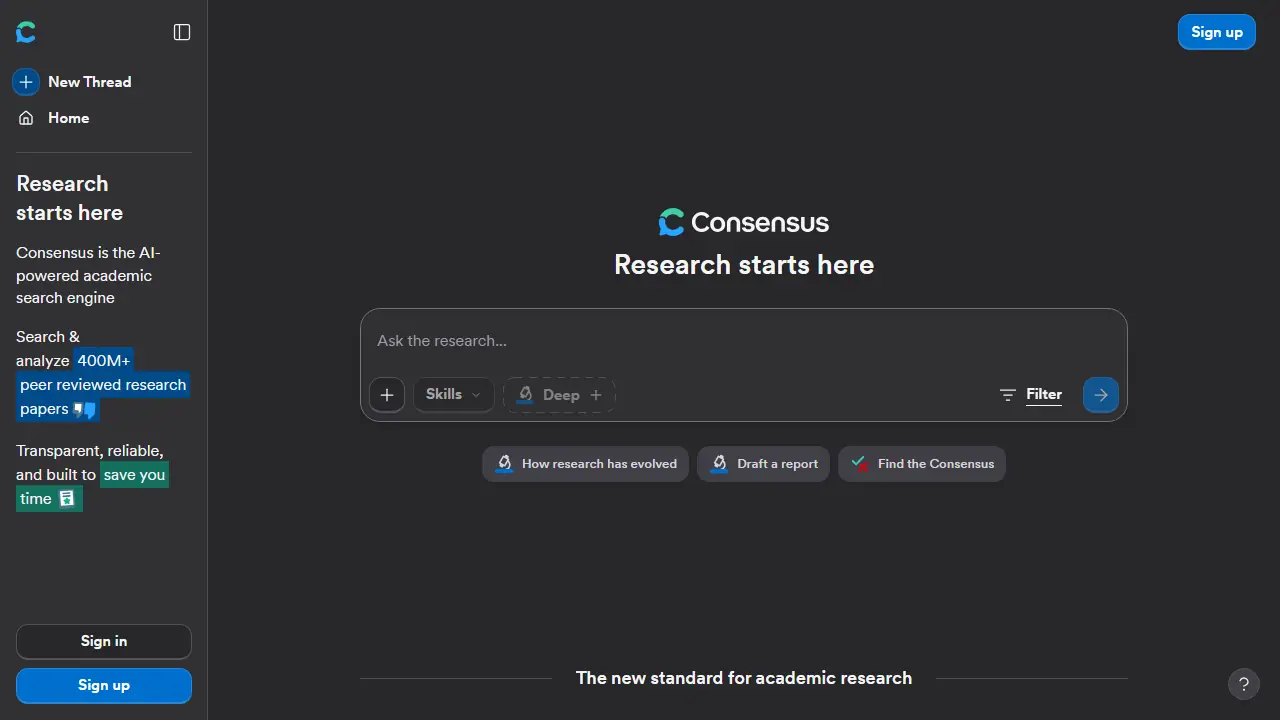
What is Consensus?
Consensus is an AI-powered academic search engine built around peer-reviewed literature. The company says it draws on more than 250 million research papers, including licensed full-text content from leading publishers, and the homepage cites over 400 million peer-reviewed papers in its search index. You ask a research question in natural language and the tool returns relevant studies with summaries and identified study designs.
Beyond basic search, you can use Deep Search, which builds a broader search strategy by expanding key terms, surfacing conflicting arguments and exploring the citation graph. A Medical mode narrows results to clinical guidelines and articles from top medical journals. For yes-or-no questions, the Consensus Meter shows at a glance how much the evidence agrees or disagrees. Filters for timeframe, population and study design can also be specified directly in the prompt.
Key features
- Search across 400M+ peer-reviewed papers using natural language questions
- Deep Search that expands terms, identifies conflicting arguments and explores citation graphs
- Medical mode limited to clinical guidelines and top medical journals
- Consensus Meter showing the level of agreement in the evidence for yes-or-no questions
- Filters for timeframe, population and study design, applied from the prompt text
- Study design identification and paper summaries
Who is it for
- Students writing literature reviews and dissertations
- Academic researchers
- Clinicians and medical professionals
- University libraries and research organizations
How to get started with Consensus
- - Go to the Consensus website and create an account.
- - Type your research question in natural language.
- - Enable Deep Search or Medical mode if you need them.
- - You need findings from peer-reviewed research for a thesis or paper.
- - You want a quick check of whether studies agree on a yes/no question.
- - You need a review of high-quality medical literature.
- - You need full access for free and do not have institutional access.
- - You need a Polish-language interface.
Pros and cons
- Access to licensed full-text content from leading publishers
- Medical mode focused on high-quality clinical sources
- Pricing details for individual plans are not shown in the provided pricing text
- Access for students and faculty depends on a valid school email or institutional partnership
Consensus pricing
| Plan | Price | Includes |
|---|---|---|
| Free | 0 USD / month | 10 wiadomości Pro i 3 Deep reviews miesięcznie |
| Pro | 12 USD / month | przy płatności rocznej (144 USD/rok), bez limitu wiadomości Pro, 15 Deep reviews |
| Deep | 45 USD / month | przy płatności rocznej (540 USD/rok), 200 Deep reviews |
Prices copied from Consensus pricing, checked October 12, 2026. Currency as shown by the vendor; taxes may apply.
Is Consensus free?
The vendor does not state this clearly on the homepage or pricing page.
Featured in
- Best AI for search - #2
Consensus alternatives
| Tool | Price from | Free plan | Category |
|---|---|---|---|
 Perplexity Perplexity | not listed | yes | AI search engines |
 Mapify Mapify | 9.99 USD/mo | yes | AI search engines |
 Kagi Kagi | 5 USD/mo | trial | AI search engines |
 Microsoft Edge Copilot Mode Microsoft Edge Copilot Mode | 9.99 USD/mo | yes | AI search engines |
 Brand24 Brand24 | 249 USD/mo | trial | AI search engines |
 iAsk iAsk | 9.95 USD/mo | yes | AI search engines |
All alternatives to Consensus →
Comparisons
FAQ
What is Consensus used for?
AI academic search engine that finds, summarizes and analyzes peer-reviewed research papers for students, researchers and clinicians.
Is Consensus free?
The vendor does not state this clearly on the homepage or pricing page.
How much does Consensus cost?
The cheapest paid plan is 12 USD/mo (vendor pricing, October 12, 2026).
What are the best Consensus alternatives?
Closest alternatives: Perplexity, Mapify, Kagi, Microsoft Edge Copilot Mode, Brand24.
Data checked October 12, 2026 on the vendor website (consensus.app).