

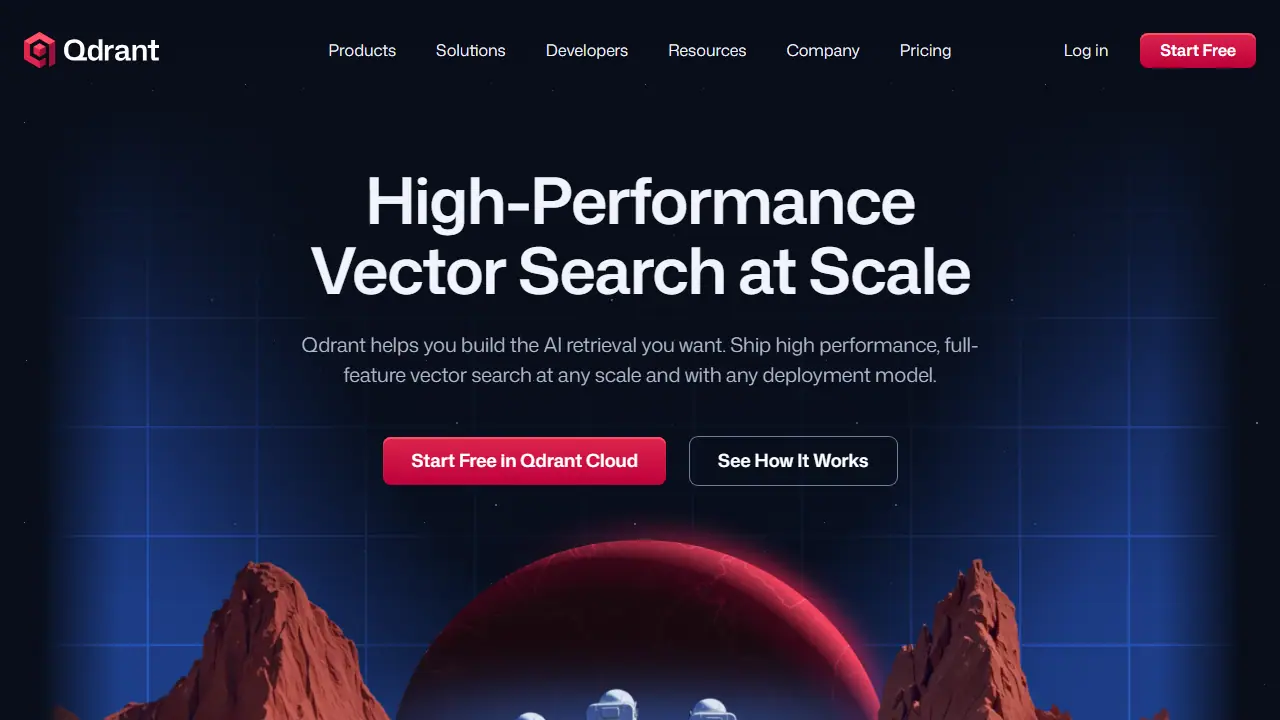
What is Qdrant?
Qdrant is a vector search engine, available as open-source software and as managed cloud services. It stores embeddings alongside JSON metadata and answers similarity queries over them, so applications can find the most relevant items for a given input. The engine is built in Rust with SIMD optimizations and a custom storage engine, and it supports dense and sparse vectors, multivector objects, hybrid keyword-plus-vector search, and filters applied during index traversal.
In practice, developers use Qdrant as the retrieval layer for RAG pipelines, recommendation systems, advanced search, anomaly detection, and AI agents. Data can be indexed in real time without rebuilding the index. Deployment options include Qdrant Cloud on AWS, GCP, or Azure, Hybrid Cloud running in your own Kubernetes, Private Cloud for air-gapped setups, and Qdrant Edge (beta) for low-latency vector search close to where data is generated.
Key features
- Hybrid search combining dense and sparse vectors (BM25, SPLADE++, miniCOIL)
- Expansive JSON metadata filters (nested, text, geo, has_vector)
- Built-in multivector support per object
- Filtering during HNSW traversal, without pre- or post-filtering
- Reranking with score boosting, late interaction models (e.g. ColBERT) and MMR
- Real-time indexing without full index rebuilds
- Managed cloud, hybrid, private and edge deployment options
Who is it for
- AI and ML engineers building RAG or search systems
- Backend developers adding recommendations or semantic search
- Enterprises with data residency or compliance requirements
- Startups building AI-powered products
Pros and cons
- Open-source core with a large community (30k+ GitHub stars)
- Built in Rust with SIMD and a custom storage engine for speed
- SOC 2 and HIPAA compliant, with SSO and RBAC on higher tiers
- Advanced cloud features such as shard splitting and GPU indexing are not in the free or standard tiers
- Premium tier requires a minimum spend and priced enterprise options are on request
Qdrant pricing
| Plan | Price | Includes |
|---|---|---|
| OSS (self-hosted) | 0 USD / empty | Open source, community support only |
| Free Tier | 0 USD / month | Single node, 0.5 vCPU / 1GB RAM / 4 GB disk, 99.5% uptime, community support |
Prices copied from the vendor website, checked October 12, 2026. Currency as shown by the vendor; taxes may apply.
Is Qdrant free?
Yes, there is a free plan. Open-source self-hosted version is free. Qdrant Cloud Free Tier is free forever for testing and prototypes: single node cluster with 0.5 vCPU, 1GB RAM and 4 GB disk, plus free cloud inference with selected models.
Qdrant alternatives
| Tool | Price from | Free plan | Category |
|---|---|---|---|
 Pinecone Pinecone | 20 USD/mo | yes | APIs & models |
 Exa Exa | not listed | trial | APIs & models |
 Firecrawl Firecrawl | 16 USD/mo | yes | APIs & models |
 Tavily Tavily | 0.008 USD | yes | APIs & models |
 You.com You.com | 1 USD | yes | APIs & models |
 Helium 10 Helium 10 | not listed | ? | APIs & models |
FAQ
What is Qdrant used for?
Open-source vector search engine written in Rust, for building fast, scalable AI retrieval and similarity search.
Is Qdrant free?
Yes, there is a free plan. Open-source self-hosted version is free. Qdrant Cloud Free Tier is free forever for testing and prototypes: single node cluster with 0.5 vCPU, 1GB RAM and 4 GB disk, plus free cloud inference with selected models.
How much does Qdrant cost?
The vendor does not publish prices publicly or requires sign-in.
What are the best Qdrant alternatives?
Closest alternatives: Pinecone, Exa, Firecrawl, Tavily, You.com.
Data checked October 12, 2026 on the vendor website (qdrant.tech).