

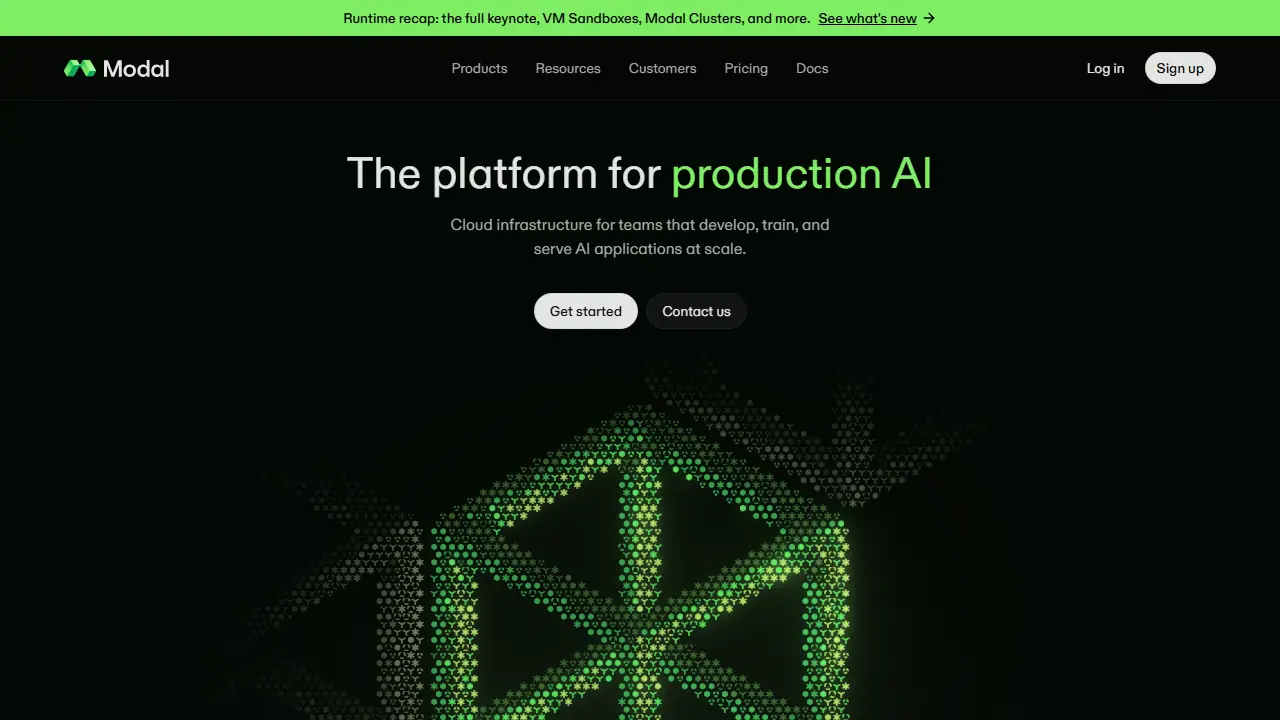
What is Modal?
Modal is a cloud platform for teams that develop, train, and serve AI applications at scale. It provides serverless compute: you write code in Python, and Modal runs it on CPUs or GPUs in the cloud, handling container images, scheduling, and autoscaling, including scaling down to zero when idle.
The product is split into three areas. Inference lets you serve LLMs and image, video, and audio models in real time or as batch jobs, with OpenAI-compatible endpoints. Training covers fine-tuning (SFT, LoRA, full fine-tunes), reinforcement learning, and multi-node GPU runs. Sandboxes are isolated environments for coding agents, RL rollouts, or running untrusted code, which can be created in large numbers quickly. Functions let you fan out work across many GPUs, run async batch jobs, or turn any function into an HTTPS endpoint.
Key features
- Serverless GPU and CPU compute billed per second
- OpenAI-compatible inference endpoints for open models
- Fine-tuning and reinforcement learning on multi-node GPU capacity
- Isolated Sandboxes for coding agents and untrusted code
- Functions that turn Python code into scalable HTTPS endpoints
- Distributed storage for model weights, datasets, and container images
Who is it for
- AI engineers and ML teams
- Startups building AI applications
- Researchers running training or RL experiments
- Developers building coding agents
How to get started with Modal
- Create a Modal account and install the Python modal package
- Write a Python function and mark it with the Modal decorator
- Run it with modal run, then deploy it using modal deploy
- You want to run AI models or train and fine-tune them on GPUs without managing servers
- You need to scale compute across many GPUs quickly and pay only for usage
- You are building coding agents or need isolated environments for running untrusted code
- You need a free plan with more containers or GPUs than the Starter plan offers
- You do not work in Python and prefer ready-made tools without programming
Pros and cons
- Pay only for actual compute time, billed per second
- Scales from zero to thousands of GPUs automatically
- Pricing grows with usage, and the Team and Enterprise tiers require a monthly base fee or a sales contact
Modal pricing
| Plan | Price | Includes |
|---|---|---|
| Starter | 0 USD / month | Plus compute usage; 30 USD/month free credits, 3 seats, 100 containers, 10 GPU concurrency, limited Scheduled and Web Functions |
| Team | 250 USD / month | Plus compute usage; 100 USD/month free credits, unlimited seats, 5000 containers, 50 GPU concurrency, unlimited Scheduled Functions, custom domains, deployment rollbacks |
Prices copied from Modal pricing, checked October 12, 2026. Currency as shown by the vendor; taxes may apply.
Is Modal free?
Yes, there is a free plan. Starter plan includes 30 USD of free compute credits per month, 3 workspace seats, 100 containers and 10 GPU concurrency.
Modal alternatives
| Tool | Price from | Free plan | Category |
|---|---|---|---|
 Google AI Studio Google AI Studio | 0,75 USD | ? | APIs & models |
 OpenAI Platform OpenAI Platform | 0,10 USD | ? | APIs & models |
 Baseten Baseten | not listed | yes | APIs & models |
 Cline Cline | not listed | yes | APIs & models |
 Amazon Bedrock Amazon Bedrock | od 0,20 USD | ? | APIs & models |
 Claude Platform (Anthropic API) Claude Platform (Anthropic API) | 2 USD input / 10 USD output | no | APIs & models |
FAQ
What is Modal used for?
Cloud infrastructure for running, fine-tuning, and serving AI models and apps on GPUs, billed per second, for developer and AI teams.
Is Modal free?
Yes, there is a free plan. Starter plan includes 30 USD of free compute credits per month, 3 workspace seats, 100 containers and 10 GPU concurrency.
How much does Modal cost?
The cheapest paid plan is 250 USD/mo (vendor pricing, October 12, 2026).
What are the best Modal alternatives?
Closest alternatives: Google AI Studio, OpenAI Platform, Baseten, Cline, Amazon Bedrock.
Data checked October 12, 2026 on the vendor website (modal.com).