

What is Mastra?
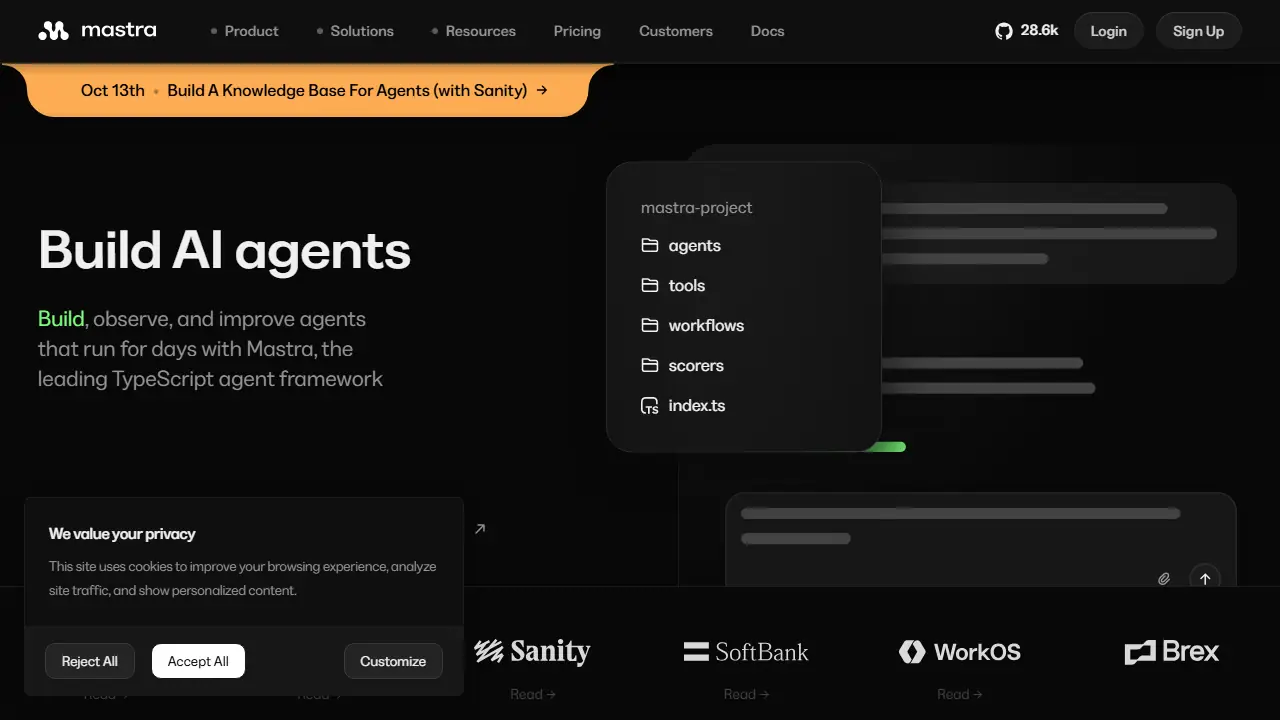
Mastra is a TypeScript framework for building AI agents and applications. Developers define agents with a model, instructions and tools, compose typed workflows with steps, retries and branches, and add durable memory such as observational memory, semantic recall and thread-aware storage. A harness coordinates multi-mode agents with shared state, and a server registers agents and workflows so the same app can run locally or be deployed to Mastra Cloud.
The package includes Mastra Studio, a local interface at port 4111 for building, testing and managing agents, workflows and tools. Observability covers traces, metrics, logs, evals, scorers and datasets. A model router gives access to thousands of models, and MCP support is mentioned on the homepage. The framework is open source under Apache 2.0, and a managed platform and enterprise self-hosted license are offered on top.
Key features
- Typed agents with models, instructions and tools
- Workflows with typed steps, retries and branches
- Durable memory with semantic recall and observational memory
- Harness for multi-mode agents with shared state
- Observability with traces, metrics, logs, evals and scorers
- Mastra Studio interface for building and testing agents
Who is it for
- TypeScript developers
- Teams building production AI agents
- Companies needing self-hosted AI infrastructure
How to get started with Mastra
- Install Node.js and create a TypeScript project.
- Define an agent with instructions, model, and tools in a TypeScript file.
- Register the agent and workflow on the Mastra server.
- Run locally and open Mastra Studio on port 4111.
- You build AI applications in TypeScript and want typed agents and workflows.
- You need observability, evaluations, and conversation memory in one framework.
- You require self-hosting and control over your data, since it is open source.
- You don't know TypeScript and don't want to learn it.
- You need a Polish-language interface, which this tool does not offer.
Pros and cons
- Open source under Apache 2.0
- Covers agents, workflows, memory and observability in one framework
- Paid tiers and usage fees apply to the managed platform
- Enterprise features require custom pricing
Mastra pricing
| Plan | Price | Includes |
|---|---|---|
| Starter | 0 USD / month | 100K observability events then $10/100K; 24 CPU hours then $0.35/hr; 15 days data retention; 10GB data egress; 1GB data storage |
| Teams | 250 USD / month | 1M observability events then $8/100K; 250 CPU hours then $0.25/hr; 6 months data retention; multiple teams, SSO, SOC 2 docs; 100GB data storage |
Prices copied from Mastra pricing, checked October 12, 2026. Currency as shown by the vendor; taxes may apply.
Is Mastra free?
Yes, there is a free plan. Free open source framework (Apache 2.0) to build and host agents anywhere; Starter plan with 100K observability events, 24 CPU hours and 15-day data retention.
Mastra alternatives
| Tool | Price from | Free plan | Category |
|---|---|---|---|
 LangChain LangChain | 39 USD/mo | yes | Website & app builders |
 Gemini Enterprise Agent Platform Gemini Enterprise Agent Platform | 0,75 USD | ? | Website & app builders |
 Pipedream Pipedream | 99 USD/mo | yes | Website & app builders |
 Langflow Langflow | not listed | yes | Website & app builders |
 Dify Dify | 590 USD/yr | yes | Website & app builders |
 JetBrains Air JetBrains Air | 100 EUR/yr | ? | Website & app builders |
FAQ
What is Mastra used for?
Open-source TypeScript framework for building, observing and deploying AI agents, workflows and tools, from prototype to production.
Is Mastra free?
Yes, there is a free plan. Free open source framework (Apache 2.0) to build and host agents anywhere; Starter plan with 100K observability events, 24 CPU hours and 15-day data retention.
How much does Mastra cost?
The cheapest paid plan is 250 USD/mo (vendor pricing, October 12, 2026).
What are the best Mastra alternatives?
Closest alternatives: LangChain, Gemini Enterprise Agent Platform, Pipedream, Langflow, Dify.
Data checked October 12, 2026 on the vendor website (mastra.ai).