
What is Microsoft Foundry?
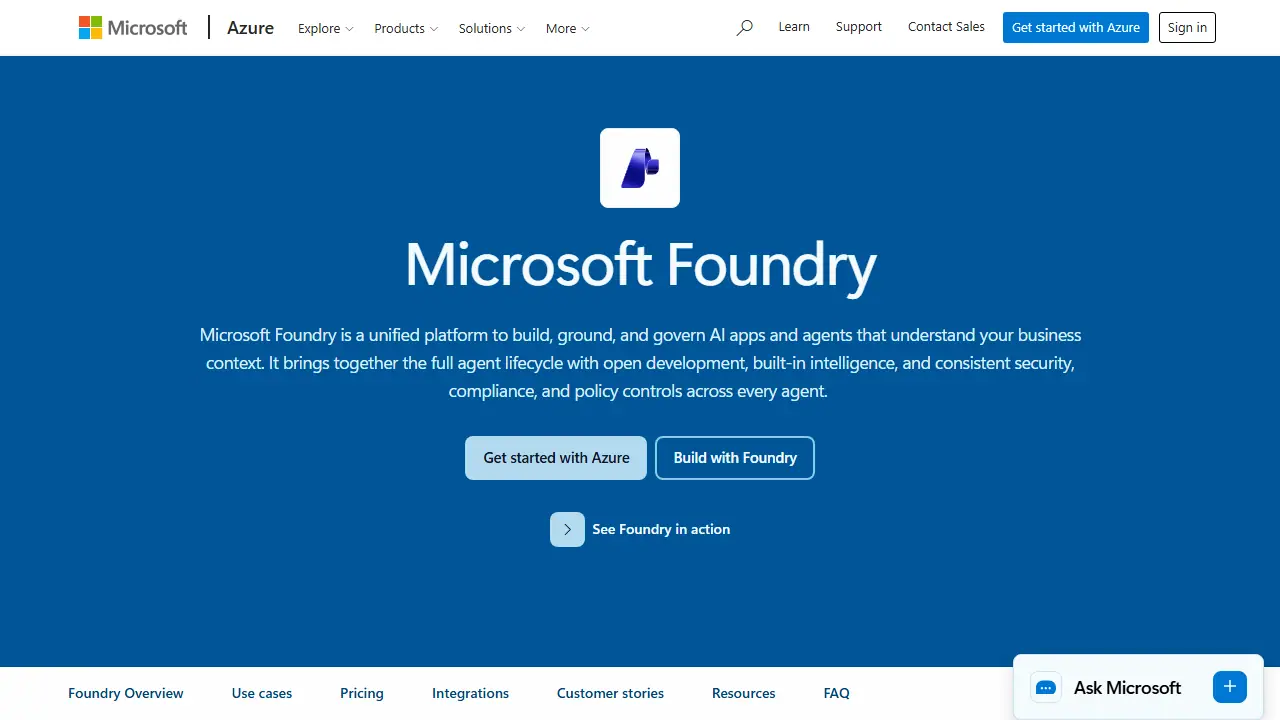
Microsoft Foundry, part of Microsoft Azure, is a unified platform for building, grounding, and governing AI apps and agents. It covers the full agent lifecycle, from model selection and fine-tuning to deployment and monitoring, with security, compliance, and policy controls applied consistently across every agent.
The platform gives access to more than 11,000 foundational, open, reasoning, multimodal, and industry-specific models, including offerings from OpenAI, Anthropic, Meta, Google, xAI, and Hugging Face. Developers can train, fine-tune, and distill models with minimal coding, and an intelligent model router selects the best model for each task to balance performance and cost. The Foundry Agent Service lets teams build context-aware agents that automate business processes, while the open-source Microsoft Agent Framework SDK supports orchestrating and creating agents.
Key features
- Access to over 11,000 models from multiple providers
- Model fine-tuning and distillation with minimal coding
- Real-time model routing to optimize cost and performance
- Foundry Agent Service for building and scaling agents
- Microsoft Agent Framework open-source SDK
- Centralized security, compliance, and policy controls
Who is it for
- enterprise development teams
- AI and data scientists
- IT and cloud architects
- businesses building AI agents
How to get started with Microsoft Foundry
- Create an Azure account and sign in to the Microsoft Foundry portal.
- Create a project and choose a model from the catalog of over 11,000 models.
- Test the model in the playground, then build an agent in Foundry Agent Service.
- Your company works within the Azure ecosystem and needs unified agent management.
- You want to compare and use models from multiple providers in one place.
- You need built-in security and compliance controls covering all AI agents.
- You need a free plan or a simple tool for an individual, as the data does not indicate free access.
- You lack familiarity with the Azure ecosystem and don't want to invest time in learning it.
Pros and cons
- Wide selection of models from multiple providers
- Consistent security and governance across all agents
- Pricing depends on the Azure services used and must be estimated with the calculator
Microsoft Foundry pricing
The vendor does not publish prices in a readable form (often pricing is shown only after signing in).
Is Microsoft Foundry free?
The vendor does not state this clearly on the homepage or pricing page.
Microsoft Foundry alternatives
| Tool | Price from | Free plan | Category |
|---|---|---|---|
 Prediction Guard Prediction Guard | not listed | no | AI agents |
 Flowise Flowise | 35 USD/mo | yes | AI agents |
 Relevance AI Relevance AI | not listed | ? | AI agents |
 Sistava Sistava | 6 USD | ? | AI agents |
 IBM watsonx IBM watsonx | not listed | trial | AI agents |
 Murph AI Murph AI | not listed | ? | AI agents |
All alternatives to Microsoft Foundry →
Comparisons
- Luma vs Microsoft Foundry
- Microsoft Foundry vs Warp
- Manus vs Microsoft Foundry
- Microsoft Foundry vs Flowise
FAQ
What is Microsoft Foundry used for?
Enterprise platform from Microsoft Azure to build, ground, and govern AI apps and agents with a wide model catalog and centralized security.
Is Microsoft Foundry free?
The vendor does not state this clearly on the homepage or pricing page.
How much does Microsoft Foundry cost?
The vendor does not publish prices publicly or requires sign-in.
What are the best Microsoft Foundry alternatives?
Closest alternatives: Prediction Guard, Flowise, Relevance AI, Sistava, IBM watsonx.
Data checked October 12, 2026 on the vendor website (azure.microsoft.com).