

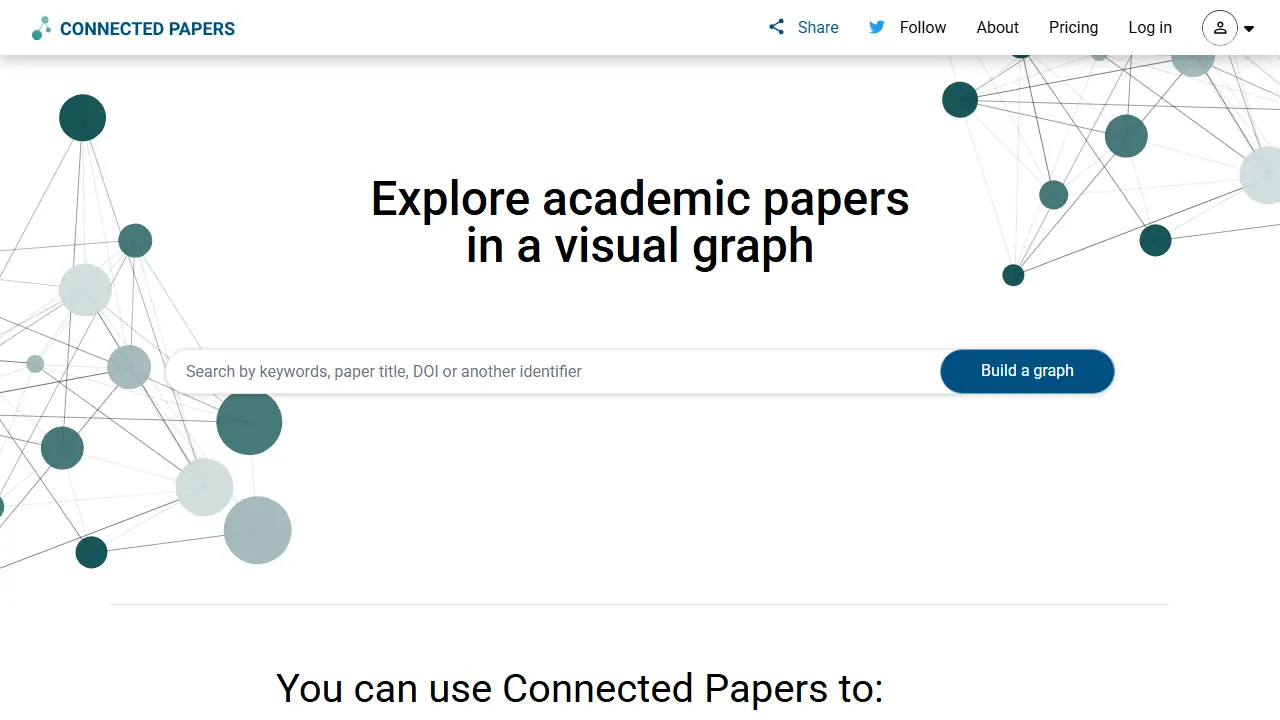
What is Connected Papers?
Connected Papers is a visual search tool for academic literature. You enter a paper identifier, such as a DOI, arXiv link, paper URL, title, Semantic Scholar or PubMed link, and the tool builds a graph of similar papers in the same field. Each node represents a paper, so you can see how works cluster and which ones are central.
Besides similarity graphs, the tool offers Prior Works, which shows important ancestor papers, and Derivative Works, which surfaces literature reviews and recent state-of-the-art papers that built on your input. Users can use it to get an overview of a new field, check they have not missed recent important papers, or fill gaps in a thesis bibliography. The database is drawn from Semantic Scholar and covers many scientific disciplines.
Key features
- Similarity graphs built from a single paper identifier
- Prior Works view for ancestor papers
- Derivative Works view for reviews and follow-up papers
- Multi-origin graphs
- Saved papers and graph history
Who is it for
- researchers
- applied scientists
- students writing theses
- academics
How to get started with Connected Papers
- Go to the Connected Papers website and create a free account.
- Enter the DOI, arXiv ID, URL, title or Semantic Scholar ID of a known paper.
- Explore the graph, then open the Prior Works and Derivative Works views.
- You are starting work in a new field and want to quickly learn the key publications.
- You are writing a thesis or dissertation and need related bibliography.
- You want to track trends and newer papers building on a chosen article.
- You need unlimited graphs for free, because the free plan covers 5 per month.
- You need a Polish-language interface, which the tool does not offer.
Pros and cons
- Visual overview of a field's trends and key works
- Covers papers from many scientific fields via Semantic Scholar
- Free plan limited to 5 graphs per month
Connected Papers pricing
| Plan | Price | Includes |
|---|---|---|
| Individuals (Free) | 0 USD | 5 graphs per month, all features included |
| Academic | 3 USD / month | Unlimited graphs, all features; for academics, non-profits and personal use; billed 36 USD annually |
| Business | 10 USD / month | Unlimited graphs, all features; for business and industry; billed 120 USD annually |
Prices copied from Connected Papers pricing, checked October 12, 2026. Currency as shown by the vendor; taxes may apply.
Connected Papers pricing details →
Is Connected Papers free?
Yes, there is a free plan. 5 graphs per month with all features included.
Featured in
- Best AI for research - #4
Connected Papers alternatives
| Tool | Price from | Free plan | Category |
|---|---|---|---|
 Semantic Scholar Semantic Scholar | not listed | yes | Research & science |
 SciSpace SciSpace | 12 USD/mo | ? | Research & science |
 ResearchRabbit ResearchRabbit | 10 USD/mo | yes | Research & science |
 Scite Scite | 20 USD/mo | trial | Research & science |
 AlphaSense AlphaSense | not listed | trial | Research & science |
 Elicit Elicit | 11 USD/mo | yes | Research & science |
All alternatives to Connected Papers →
Comparisons
- NotebookLM vs Connected Papers
- Elicit vs Connected Papers
- Semantic Scholar vs Connected Papers
- Wolfram|Alpha vs Connected Papers
FAQ
What is Connected Papers used for?
Visual graph tool that maps academic papers related to a given paper, helping researchers explore and track a field.
Is Connected Papers free?
Yes, there is a free plan. 5 graphs per month with all features included.
How much does Connected Papers cost?
The cheapest paid plan is 3 USD/mo (vendor pricing, October 12, 2026).
What are the best Connected Papers alternatives?
Closest alternatives: Semantic Scholar, SciSpace, ResearchRabbit, Scite, AlphaSense.
Data checked October 12, 2026 on the vendor website (connectedpapers.com).